
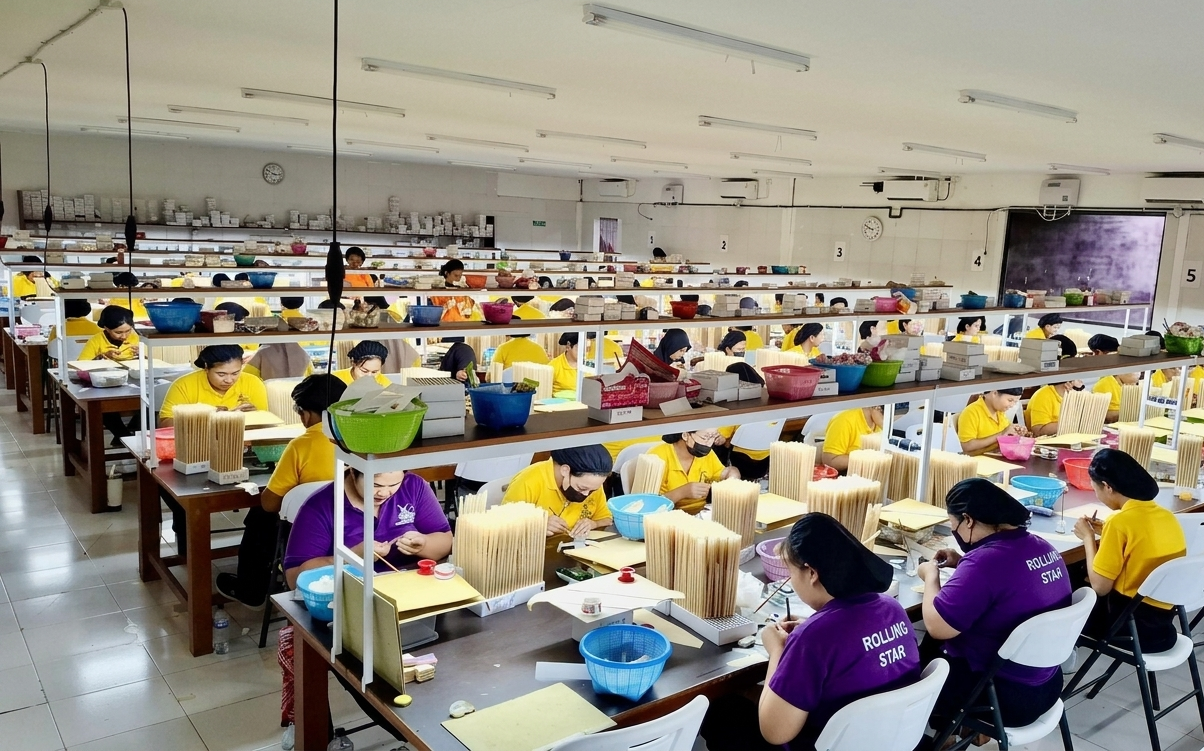
Most buyers focus on the finished cone. However, what separates a reliable manufacturing partner from an average one is what happens before the product is ever packaged. The entire factory journey, from the first roll of paper to the final quality check, is where consistency is either built or lost. Understanding innovative paper cones factory techniques helps wholesale buyers, distributors, and private label brands make more informed sourcing decisions, not just better purchases.
Inside Innovative Paper Cones Factory Techniques
A pre rolled cone begins its life as a raw material decision. Paper selection is not a passive step. On the contrary, it is the moment where a manufacturer's technical knowledge becomes most visible. Weight, porosity, grain direction, and surface texture all affect how the cone will behave during rolling, how it will burn in use, and how consistently it will perform across a full production batch.
From raw paper, the cone moves through a tightly sequenced process: tensioning, spiral winding, crutch insertion, tip forming, and calibration. Each stage creates a narrow window for error. Moreover, each stage is also an opportunity for genuine innovation, in tooling precision, machine speed calibration, material handling, and quality gate design.
What distinguishes innovative paper cones factory techniques from standard production is not the presence of automation alone. Rather, it is the integration of craft-level attention into every mechanical stage. At Dutch Mill Cones, each production run is monitored for fill weight tolerance, cone geometry, and tip integrity. Because a cone that looks right but burns unevenly is a product failure, regardless of how cleanly it was rolled. As a result, buyers who understand this process are better equipped to evaluate manufacturer quality before committing to a bulk order.
Breaking Down Advanced Cone Manufacturing Processes Step by Step
Advanced cone manufacturing processes follow a precise sequence that determines both product quality and batch consistency. Understanding each stage helps buyers identify which questions to ask when evaluating a manufacturer's capabilities.
- Paper Tensioning. Before rolling begins, the paper feed must be maintained at a consistent tension. Variations in tension cause uneven wall thickness, which directly affects draw resistance. A manufacturer with proper tensioning controls produces cones that pull uniformly across the full batch.
- Spiral Winding Mechanics. The cone body is formed through a spiral winding process where paper is wrapped at a calculated angle around a mandrel. The winding angle determines the taper profile and structural integrity. Moreover, the speed and pressure applied during winding must be precisely matched to the paper weight being used. A mismatch results in weak seams or over-compressed walls.
- Crutch Insertion. The crutch, or filter tip, is inserted at the base of the cone during or immediately after winding. Accurate crutch placement affects airflow and draw consistency. In addition, the material and diameter of the crutch must be matched to the cone size to prevent gaps or compression that would restrict the draw.
- Tip Forming. The tapered tip is shaped and closed at the narrow end of the cone. This step requires consistent pressure and timing to produce a tip that holds its shape without cracking or collapsing under filling pressure.
- Final Calibration and Quality Inspection. Each cone is measured for fill capacity, tip integrity, and overall geometry before packaging. Consequently, any unit that falls outside tolerance is removed from the batch, protecting the buyer's product consistency downstream.
Material Science Behind High-Performance Pre Rolled Cones
The paper a manufacturer chooses is not a commodity decision. It is a performance specification. Three material types dominate the market, and each behaves differently across the key variables that matter to end users: draw resistance, burn rate, and flavor neutrality.
- Rice paper is the thinnest and most neutral option. It burns slowly and evenly, produces minimal ash, and has the lowest impact on the taste of the product. However, its low tensile strength makes it more demanding to work with during high-speed winding.
- Hemp paper has grown significantly in demand, particularly in the USA and EU markets. It is slightly thicker than rice paper, burns at a moderate rate, and offers a natural material story that resonates with sustainability-focused consumers. As a result, it has become the preferred choice for many private label brands targeting premium retail.
- Unbleached kraft paper delivers durability and a natural aesthetic. Its higher porosity can affect draw resistance, making calibration during winding especially important. On the other hand, its visual texture and unprocessed appearance align well with brands positioning around organic or artisanal identity.
Beyond paper type, sustainable production methods are increasingly influencing material selection. Buyers in Germany, the UK, and Australia in particular are requesting documentation on pulp sourcing, bleaching processes, and overall environmental footprint. These considerations are also part of the broader evaluation process outlined in our guide on selecting a trusted pre-rolled cones manufacturer, where material sourcing, manufacturing standards, and quality assurance all play a critical role in choosing the right production partner.
Latest Advancements in Manufacturing Processes for Paper Cones and Their Significance
The most significant recent advancement in custom cone design manufacturing is the shift toward modular production systems. Rather than running a single fixed cone format across an entire facility, leading boutique manufacturers have invested in tooling systems that allow rapid changeover between cone sizes, taper profiles, and crutch configurations. This means a private label brand can order a distinct cone format without committing to the production volume that was previously required to make customization economically viable.
Precision tip-forming technology has also advanced considerably. Older tip-forming methods relied on manual pressure adjustment, which introduced variability across large batches. Newer approaches use calibrated forming tools that apply consistent force regardless of operator variation. Consequently, tip quality is now a controllable variable rather than an accepted inconsistency.
Quality inspection has moved toward integrated measurement at each production stage rather than only at the end of the line. This approach catches deviations earlier, reduces material waste, and produces more consistent output at the batch level. For wholesale buyers managing their own quality control in cone production, this shift is significant. It means fewer surprises when the shipment arrives. Furthermore, digital batch tracking now allows manufacturers to provide buyers with production records tied to specific order runs, which supports traceability requirements increasingly demanded by regulated markets.
Partner With a Factory That Puts Innovation Into Every Cone
Innovation in cone manufacturing is not a feature reserved for large-scale factories. In fact, boutique manufacturers who combine handcrafted precision with structured quality systems often deliver more consistent results than high-volume competitors. The difference lies in the depth of attention applied at each production stage.
Ready to source from a manufacturer that combines handcrafted precision with innovative paper cones factory techniques? Contact Dutch Mill Cones to discuss bulk orders, private label programs, and custom cone specifications tailored for your market.